Charlotte Bastian & Gonzalo Reyes Araos: The Unstable Horizon
Charlotte Bastian & Gonzalo Reyes Araos: The Unstable Horizon
Historically, the horizon has been the line that guarantees orientation: the point of reference that enabled us to locate ourselves in space, distinguish the sky from the earth. Yet in the contemporary era—marked by the proliferation of screens, temporal acceleration, and the radical transformation of our environment—this horizon has become fundamentally unstable.
The Unstable Horizon brings together the practices of Charlotte Bastian and Gonzalo Reyes Araos in a dialogue exploring precisely this condition: how technology, perception, and human interventions have redefined our capacities to understand and inhabit space.
Bastian and Reyes Araos share a central concern: not to represent the world, but to transform the viewer's perceptual experience. Their strategies, however, diverge significantly.
Bastian works with drawing, 3D models, photography, and stereoscopy—a technique that externalizes depth perception and reveals how we visually experience space. By creating collages and animations that require the use of 3D glasses or intermediary optical devices such as stereoscopes or lenticular prints, she introduces "controlled shifts" into the act of seeing. Viewers experience landscapes as simultaneously strange and familiar, present and absent. Here, the stereoscopic effect is also an inquiry into perception itself. It demonstrates that spatial depth is experienced as objective reality, even though it is merely the product of a sensory and technological apparatus.
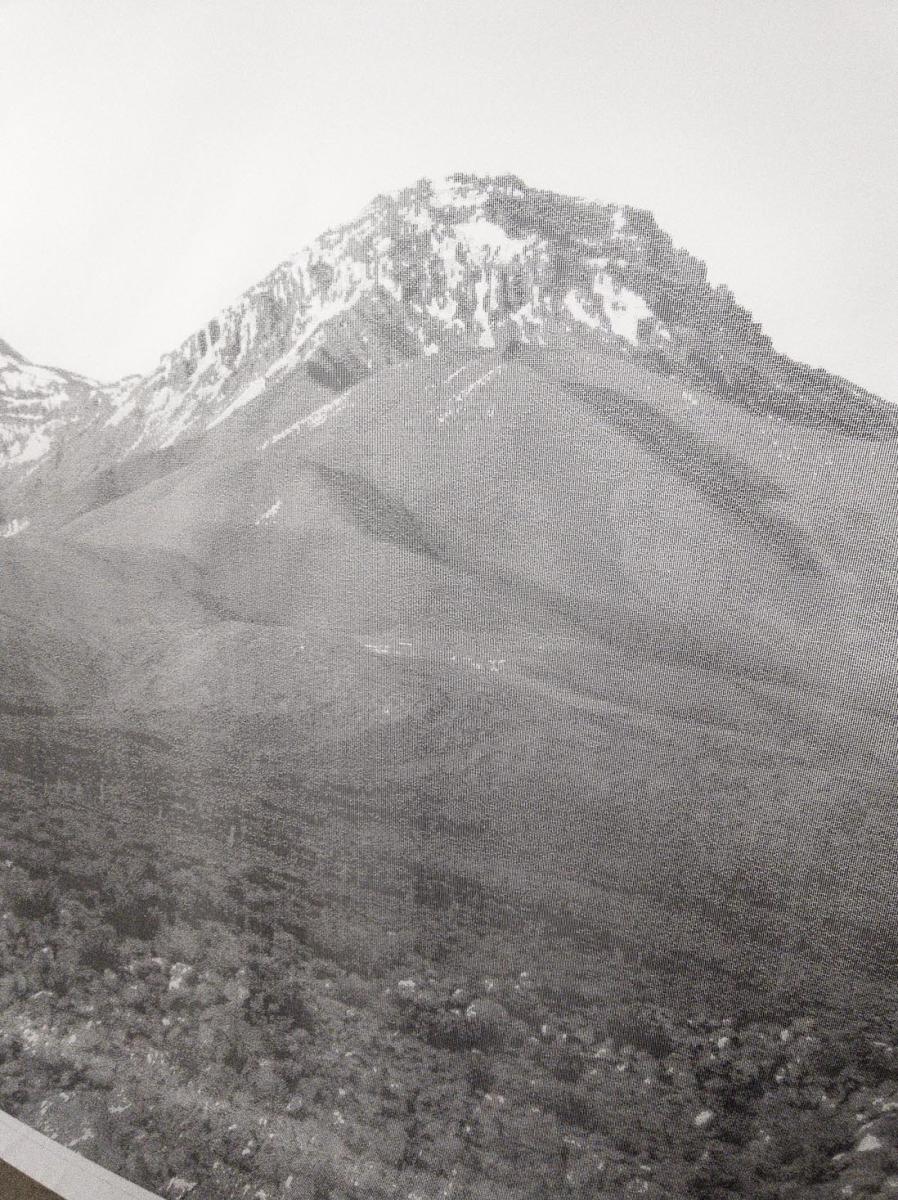
Reyes Araos, by contrast, works with code and light—the invisible materials of digital communication. His ASCII volcano transforms binary characters into a sacred mountain, merging ancestral language and digital code into a single image. Where Bastian produces a visual displacement, Reyes Araos effects an ontological collapse: the distinction between representation and existence begins to dissolve. The image becomes an invocation, and code becomes a vehicle of spiritual agency.
Both artists investigate the traces of human intervention in the contemporary world, albeit from different perspectives.
Bastian's work centers on transience and the marks of human activity in the Anthropocene. Her works are not documents but visual constructions that deliberately generate cognitive dissonance and often evoke an unsettling atmosphere.
Drawing on multiple photographs she has taken herself, she constructs scenarios characterized by temporal disjunction and spatial indeterminacy, where remnants of nature, idyllic landscapes, desolation, and ruined architecture coexist. This impression is further enhanced in the spatial collages: the sense of depth created by viewing the works in three dimensions conveys an almost immersive feeling of being within these strangely familiar landscapes.
The animated film Pilin addresses the melting of a glacier. Bastian created the animation by drawing directly in the virtual three-dimensional space, allowing the camera to move freely around the drawings. Presented stereoscopically on a 3D monitor and viewed with 3D glasses, the drawings acquire a tangible spatial presence.
Reyes Araos, conversely, examines how technology has colonized even our ancestral cosmologies. The Paniri volcano—a sacred site in Atacameño culture—is translated into code, rendered in ASCII, and printed on fabric. According to Atacameño belief, volcanoes, known as Tata Mallkus, function as bridges between heaven and earth.
The ASCII method (American Standard Code for Information Interchange) deconstructs the digital image by replacing each pixel with a text character, thereby creating a grayscale visual equivalent. The specific characters composing this work are determined by the phrase "Ay la hoy'ri peni cachii li cielo," which translates from Kunza as "So on earth as in heaven."
Translating an image into code is a paradoxical fusion: the ancestral word that creates reality persists, yet now must express itself in ASCII. The work honors the generative capacity of indigenous language while interrogating how digitalization transforms it, preserves it, displaces it.
The window installation filters incoming daylight through red, green, and blue films, breaking it down into the three primary colors of the RGB color space. The three colors from which digital screens generate their images. In this way, the work intertwines immediate spatial perception with the digital construction of images.
The exhibition's title suggests that instability is not a problem to be solved, but rather a condition to be inhabited critically. Neither Bastian nor Reyes Araos offer synthesis or certainties. Instead, their works maintain tensions.
This is the political gesture of The Unstable Horizon: to recognize that we live in a reality in which traditional frames of reference—the horizon line, the distinction between nature and artifice, between presence and absence—have become unsustainable. And that, far from being catastrophic, this opens a space for new forms of perception, knowledge, and existence.
What both artists offer is not information but embodied experience. Bastian's 3D glasses, Reyes Araos's ASCII characters, the monumental scales, the specific materials—everything functions to destabilize the viewer, forcing recognition that one is seeing, perceiving, being transformed in the act of contemplation.
In an era when horizons multiply (digital, cosmological, geopolitical), these practices invite us to pause and ask: How do we orient ourselves when the compass itself has become unstable? What new forms of knowing and being emerge from this disorientation?
ARTWEEK: Thu 10 Sept + Fri 11 Sept 26, 3 pm – 7 pm
Sat 12 Sept and Sun 13 Sept 26, 2 pm – 6 pm